
Donec efficitur, ligula ut lacinia
viverra, lorem lacus.
Donec efficitur, ligula ut lacinia
viverra, lorem lacus.


Planning a wedding day timeline gives couples a clear structure without requiring every minute to be rigidly scheduled. There is no single timetable that suits every wedding: ceremony time, travel, photography, venue access and reception plans all make a difference. A civil ceremony in a town hall will flow differently from a religious ceremony followed by a country-house reception. The aim is simply to know what needs to happen, when, and who is responsible. Build in realistic buffers, allow time to eat and breathe, and treat the schedule as a guide rather than a clock you have to chase all day.
Your wedding morning should be planned backwards from the ceremony, rather than by choosing an arbitrary start time.
For example, an afternoon ceremony gives you more preparation time than a 12pm ceremony. Work backwards from the ceremony and consider:
If several bridesmaids or family members are having professional hair and makeup, the preparation may need to begin much earlier than expected.
Here is an example wedding day schedule for an afternoon ceremony followed by an evening reception:
| Approx. Time | What Happens |
| 8:00 am | Breakfast and final preparations |
| 9:00 am | Hair and makeup underway |
| 11:00 am | Getting-ready photographs |
| 12:00 pm | Wedding party gets dressed |
| 12:30 pm | Final checks and transport |
| 1:00 pm | Guests begin arriving |
| 1:30 pm | Ceremony |
| 2:00 pm | Confetti and congratulations |
| 2:15 pm | Group and couple photographs |
| 3:30 pm | Drinks reception |
| 4:30 pm | Wedding breakfast |
| 6:00 pm | Speeches |
| 6:30 pm | First dance |
| 6:45 pm | Dancing and evening celebrations |
| 8:00 pm | Evening food |
| 10:30 pm | Final celebrations |
| 11:30 pm | Couple departure |
These are example timings, not rules. Your venue, ceremony length, travel arrangements and reception format may require a very different schedule.
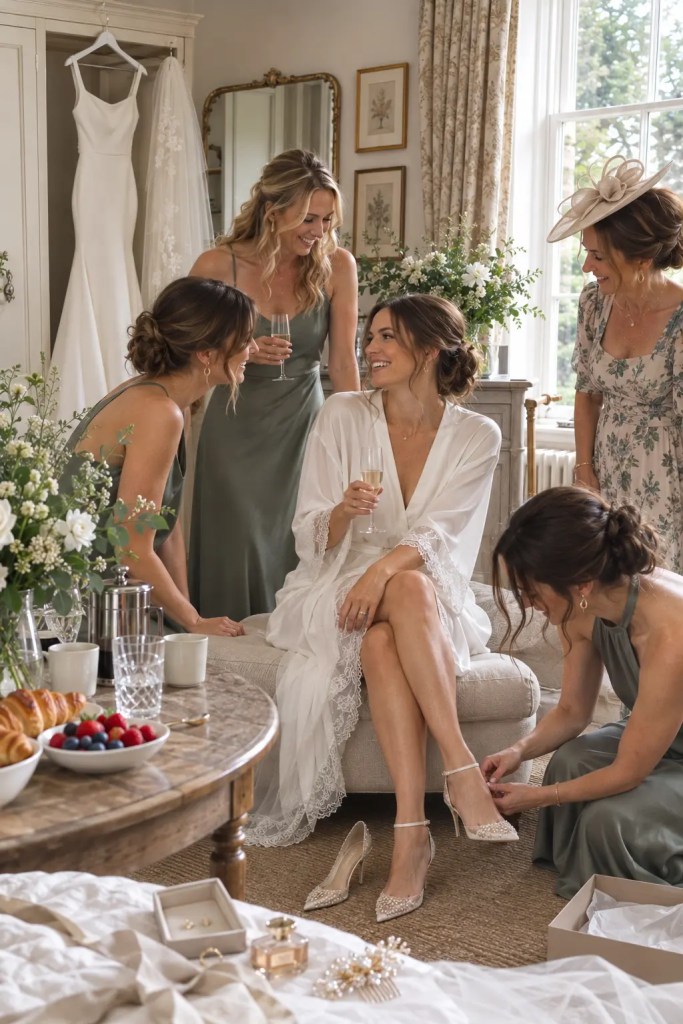
A calmer wedding morning starts with practical preparation. Eat something substantial, drink water and keep the getting-ready room reasonably organised.
Have outfits, shoes, jewellery, rings and other accessories ready before the photographer arrives. Keep important documents accessible and allow extra time for hair and makeup rather than scheduling everything back-to-back.
It can also help to nominate one trusted person to answer supplier calls. The couple should not spend the morning dealing with questions about transport, deliveries or venue access.
Bridesmaids, groomsmen and family members may also need separate preparation schedules, particularly if they are using the same hair and makeup team.

There is no universal start time for bridal hair and makeup. The number of people having services, hairstyle complexity, makeup requirements and photographer arrival all affect the schedule.
Allow enough time for the bride or groom to get dressed without immediately rushing into photographs. A useful approach is to finish the main beauty appointments before the final photography and dressing period, leaving a buffer for touch-ups.
The couple also does not necessarily need to be the final people in the chair simply because they are the focus of the day. A well-planned sequence can make the entire preparation period smoother.

Your photographer may begin capturing details and candid preparation well before the ceremony. Typical photographs can include:
Gathering important details in one place is particularly helpful. It means the photographer can photograph everything efficiently rather than spending valuable preparation time searching through different rooms.
For more ideas about the photographic style couples are choosing, see Wedding Photography Trends Every British Couple Loves.

Both approaches can work well; the choice mainly affects the rest of your wedding timeline UK.
Neither option is automatically better. Choose the approach that fits the experience you want and then build the photography schedule around it.

Do not treat the estimated driving time as the complete journey.
Your wedding day schedule should account for getting into vehicles, parking, traffic, venue entrances, loading and unloading, weather and finding the correct room once you arrive.
If the journey is expected to take 25 minutes, scheduling arrival exactly 25 minutes later leaves almost no room for anything unexpected. A sensible buffer gives the day more flexibility, particularly when several people are travelling together.

The ceremony usually includes guest arrival, the processional, the ceremony itself, any required formalities, the recessional and congratulations.
The exact sequence and duration depend on whether you are having a civil, religious or other type of ceremony. Legal and procedural requirements can also vary, so confirm the details with your officiant and venue rather than relying on a generic timetable.
If confetti is planned, make sure someone knows where guests should gather afterwards and who will organise it.

The first half-hour after the ceremony can quickly become chaotic. Guests want to congratulate you, family members need gathering for photographs and the couple may also need portraits.
Decide in advance who will help organise family members for group photographs. A designated helper can save the photographer from trying to locate everyone.
Ideally, guests should then have a clear route towards the drinks reception while the couple completes any remaining photographs.

There is no universal wedding photography timeline. The duration depends on how many formal photographs you want and whether you have a first look.
Allow enough time for relaxed photographs without making the couple feel as though they are being rushed from one pose to another.
Keep the formal list focused. Too many combinations can consume a surprisingly large part of the reception.
Agree the combinations beforehand so everyone knows when they are needed.
Leave space for your photographer to capture natural conversations, laughter and interactions throughout the day.
A shorter, organised formal photo list can give you more time to enjoy the reception.

The drinks reception usually provides space for drinks, canapés, guest photographs and relaxed couple portraits.
Depending on the venue, you might also have:
This period can also act as a useful buffer. If the ceremony or photographs take slightly longer than expected, guests can remain occupied while the venue team prepares for the wedding breakfast.
Once guests are seated, the couple may make an entrance before meal service begins. Depending on the venue and personal preference, speeches can take place before the meal, between courses or afterwards.
A typical sequence might include:
Guest seating → couple entrance → meal → speeches → dessert → coffee → evening transition
However, there is no requirement to follow this exact order. Your caterer and venue team can help determine what works best with the service style.
Speeches can happen before dinner, between courses, after the meal or during the transition towards the evening reception.
Having them before or between courses can break up the meal, while speeches after dinner allow guests to eat without interruption. The most important consideration is that the meal remains comfortable and the speeches do not make guests wait unnecessarily for food.
Keep the overall experience in mind rather than choosing a position simply because it is traditional.
The transition should be planned rather than left to chance.
Consider whether you need to:
Venue staff should coordinate the practical changes while guests receive clear information about where they need to go next.
If you are deciding between entertainment options, our guide to Wedding DJ vs Live Band can help with the planning decision.
The first dance, cake cutting and entertainment can all fit naturally into the evening, but couples do not need to include every traditional activity.
You might have the first dance followed by an open dance floor, with the cake cutting later. Alternatively, the cake can be cut before dancing begins.
A DJ or live band can work around these moments, while evening food can be introduced once guests have had time to dance.
If you are booking a DJ, it is also useful to prepare practical information in advance with a Wedding DJ Checklist for UK Couples.
Evening food depends on when the main meal finishes and how long the reception continues.
Some couples serve food shortly after dancing begins, while others wait until later. Buffet-style food may be easier for guests to access casually, while served options create a more structured experience.
Remember to consider dietary requirements and guests who arrive specifically for the evening reception.
A wedding can become a sequence of scheduled activities unless you deliberately create breathing space.
Try to find even a few minutes to:
These pauses do not need to appear as formal events on the public schedule. They simply need to exist somewhere in the day.
The final part of the timeline may include final dancing, last drinks, guest departures and the couple’s journey to their accommodation.
There may also be practical jobs involving:
Ideally, the couple should not be responsible for these tasks. Nominate a trusted person, coordinator or family member to oversee practical end-of-night arrangements.
Treat the ceremony as the fixed point around which the rest of the day is organised.
Calculate how long hair, makeup, dressing and preparation realistically require.
Include parking, loading, traffic and venue access rather than relying solely on estimated driving time.
Decide when details, preparation, group photographs and couple portraits will happen.
Confirm the order with your venue and caterer.
Include entertainment, dancing, cake cutting, evening guests and food.
Protect time for eating, relaxing and simply being together.
Give the final schedule to your venue, photographer, videographer, caterer, entertainment team and wedding party so everyone understands what is happening and when.
Scheduling everything too tightly: Leave breathing space between major events.
Forgetting travel time: Include parking, loading, walking and potential delays.
Not allowing enough time for photographs: Agree your formal photo list before the day.
Making the family photo list too long: Keep combinations practical and nominate someone to gather people.
Forgetting meals for the couple: Make sure you actually have time to eat.
Leaving no buffer: Build flexibility into transitions.
Scheduling too many formalities: Include only traditions that matter to you.
Not telling suppliers about the timeline: Share the final version before the wedding.
Forgetting evening guest arrivals: Give evening guests clear arrival information.
Giving the couple practical jobs: Delegate supplier questions, gifts and transport arrangements.
Not planning the final departure: Confirm transport and belongings before the reception gets busy.
There is no standard starting time. The wedding morning timeline depends on the ceremony, preparation requirements, photography and travel arrangements.
There is no universal duration. The number of family combinations, wedding-party photographs and couple portraits will determine how much time you need.
Both can work. Speeches before or between courses can break up the meal, while speeches after dinner allow guests to eat without interruption. Discuss the options with your venue and caterer.
Some flexibility is essential because travel, photographs, guest movement and venue transitions rarely happen with absolute precision. Avoid planning every transition down to the minute.
Yes, if it matters to you. Even five quiet minutes together can provide a welcome pause during a busy reception and give you an opportunity to appreciate the day together.
A good wedding day timeline should provide structure without making the celebration feel controlled by the clock. Start with your ceremony, work backwards through preparation and travel, then build in realistic time for photography, food, speeches, entertainment and proper breaks. Your priorities should shape the final schedule rather than a generic wedding formula. Once complete, share it with your venue, suppliers and wedding party so everyone knows their role. Most importantly, leave enough flexibility for the conversations, laughter and unexpected moments that no timetable can predict.


